Breaking open the craft of writing: Stephanie Bolster on witnessing and expressing the 'overwhelm of contemporary life'
- Sheelagh Caygill

- Oct 21, 2025
- 5 min read

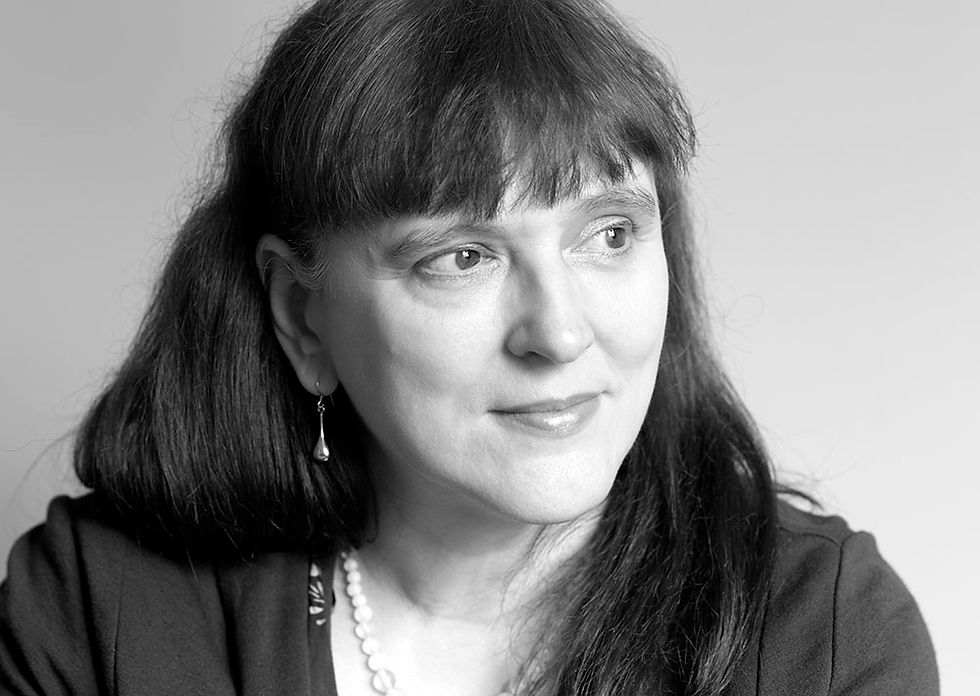
Stephanie Bolster has published five books—the first of which, White Stone: The Alice Poems, won the Governor General’s Award in 1998—and edited The Best Canadian Poetry 2008. Born in Vancouver, she is a professor of creative writing at Concordia University in Montréal.
Her most recent book, Long Exposure, explores, among other subjects, photographs taken in the aftermath of Hurricane Katrina. Stephanie explores breaking open the craft of writing, why she loves books that are difficult to describe, writing written ekphrastically, and the evolution of her form and approach to writing.
Breaking open the craft of writing
OCW: Has your writing evolved over the years? If so, how? Through writing experience? Reading a lot? Writing courses or communities? A combination, or something else?
SB: I believe my writing has become increasingly distinctive. While the content, language, and syntax of my work remain accessible, my form and approach have become more immediate and less literary.
Initially, like most writers, I wrote primarily one-page lyric poems. In my late teens and early twenties, I began to write series of poems about a single subject. By my third book, Pavilion, I was writing longer poems created of briefer passages or fragments. My fifth and current book, Long Exposure, is a long poem that moves continuously from one page to the next. Although it includes some titled “poems,” these aren’t discrete but exist in conversation with other such pieces within the book.

This evolution in my work has arisen, in part, out of a desire to challenge myself—to not keep on writing the kind of poem I already know how to write. As a teacher, I read a lot of brief lyric poems, and I know how hard they are to write well. Not only my interests but my abilities lend themselves to longer forms.
The less time I have to write, the more I want to ensure I’m pursuing work that only I can write, in a mode that challenges me to write with honesty and freshness. I want to write in a voice that sounds like me, not a voice that I think someone will praise. Having devoted much of my life to helping writers craft well-made poems, I’m finding it invigorating to break open that craft, to express the mess and overwhelm of contemporary life.
The responsibility of witnessing and of art making
OCW: Can you trace any common themes across your writing?
SB: I’ll never stop writing about the passage of time—its mysteries and gifts and heartbreak.
I’ve often written ekphrastically, and even before I began writing about visual art, I was writing about perception; in my first creative writing class at UBC as an undergraduate, I wrote a pair of poems called “Watcher” and “Watched.” Over 35 years later in Long Exposure, I’m still exploring the responsibility of witnessing and of art-making, and my own role as a writing and perceiving subject.
Place and displacement, too, preoccupy me. Early in my career I wrote about coming to appreciate the place I grew up and lived in, BC’s Lower Mainland. Then I moved away. I’ve now lived away from BC longer than I lived there, yet I’m still writing about that place and not being there. I’m also writing about those who don’t get to choose whether to stay or leave.
OCW: Which authors and/or types of books do you like to read?
SB: I’m most interested in books that are difficult to describe, books that don’t easily slot into marketing categories or bookstore shelving arrangements. Work that pushes generic boundaries and that explores other disciplines, such as history or the sciences. The works of W.G. Sebald are those I’d most like to have written—the play between creative non-fiction and fiction fascinates me, as does his digressive approach to syntax and structure, and his inclusion of photographs.
I love Maggie Nelson’s The Argonauts, another un-pin-downable book. Anne Carson’s work, which is like nothing else except Anne Carson’s other work. The poetry of C.D. Wright. I’m also very excited by the work that the students with whom I work at Concordia are writing. Emerging writers now are much quicker to question genre boundaries than I was at their stage. It’s exhilarating.
AI and literary work: Why the glitches are more interesting than the successes
OCW: Do you see generative AI as a threat or benefit to writers?
SB: It’s both and it’s neither. I find it fascinating and terrifying to think about, but I’ve never actually used it.
If by “writers” we’re talking about technical writers, I can see ways in which AI could be a threat, though we’ll still need humans to vet the AI’s work.
When it comes to literary work, humans definitely come out on top. I read a piece last summer in The New York Times (“Can You Tell Which Story Chat GPT Wrote?”) in which an AI had been fed the work of the writer Curtis Sittenfeld in order to create an imitation of her work. I could tell from the first sentence of each piece which was written by an AI and which was written by a human.
Coincidentally, my brother, who isn’t a creative writer, read the same article and had the same experience. AI is a serious issue when it comes to students writing essays, but when it comes to writing literary work, especially poems, I don’t believe it has the heart and the imagination to create work that’s comparable to that of a human who’s been honing their attention and craft for a lifetime.
That said, experimenting with AI has the potential to create fascinating work. If a writer asks thoughtful, discerning questions of the AI they’re using, and if they let in the failures, the errors, there’s the potential to create literary approaches we’ve never seen before. Out of a process that is by its nature unoriginal, since the AI is fed only work that already exists, can come material that’s messy and weird. From a literary perspective, the glitches are more interesting than the successes.
I had the pleasure and privilege of supervising Adam Haiun’s work on I Am Looking for You in the No-Place Grid; it’s a poetry book written in the voice of an AI, and although it was published this last spring, it was written – entirely unassisted – before Chat GPT was released. It’s one of the most utterly original things I’ve read.
OCW: Do you edit as you write, or write and edit later?
OCW: Both! Although my initial writing process is basically to spew out whatever comes into my consciousness, unfiltered, I do find myself – because I can think a little more quickly than I can type—revising my “first thought” even before it’s hit the page, and sometimes backspacing to change a word I’ve just written.
Most of my editing happens later, though. Sometimes much later. I’m evolving as a human being during the years it takes me to write a book, so it’s inevitable that the now-me is going to at least be tempted to alter what then-me wrote. My editorial process consists largely of taking away, letting go. As the sludge clears away, I begin to see the shape of what I’m making, and so I can continue to make it—or unmake it—with greater clarity and intentionality.


Comments