The don't-draft-and-craft approach to writing: An interview with Ann Cavlovic
- Sheelagh Caygill

- Mar 13
- 3 min read
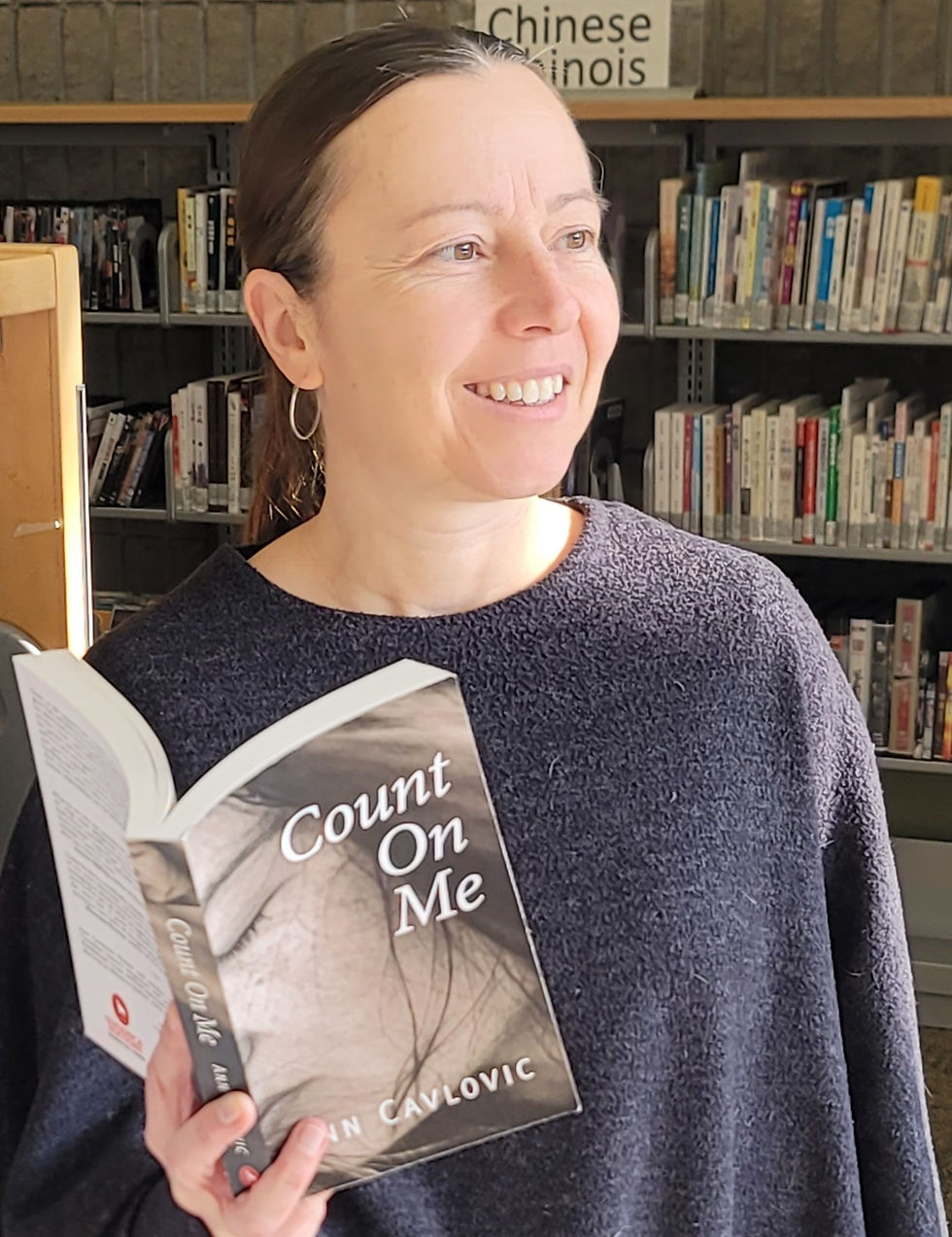
Count On Me is Ann Cavlovic’s debut novel (Guernica Editions, 2025). Her fiction and creative non-fiction have appeared in Event, The Fiddlehead, The Globe and Mail, Grain, Little Bird Stories, PRISM international, Room, SubTerrain, the Anthology This Place a Stranger (Caitlin Press), and elsewhere. She was the recipient of a grant from the Canada Council for the Arts, and her work has placed in several writing contests. Ann lives in the Outaouais region of Western Quebec, just outside of Ottawa, Canada.
Navigating the tension between market and intimacy
OCW: What life experiences have shaped your writing style?
AC: I’m fascinated with tensions between love and money. Why? Probably due to a whole cacophony of life experiences, like any writer. We could start with parents who were on completely different extremes of the consumer culture spectrum. Add to that having money taken from me by people I trusted too many times.
This probably led me into studying to be an economist (an environmental economist specifically). Although I didn’t know it consciously, I think I was motivated by a desire to study love by process of elimination. There’s nothing necessarily wrong with market transactions, of course. You need some shoes, I need some grain, great, let’s swap. But even though any human relationship involves a certain amount of give and take and we all have material needs, it’s certainly not a compliment if we describe an intimate relationship as being “transactional,” is it? So, what’s the boundary? How do we discern true intimacy from a “give-to-get” strategy? If we look closely at any relationship, it can take some time to see the difference.
OCW: Can you trace any common themes across your writing?
AC: My number one theme is around love and money, as discussed above. I also tend to weave in environmental themes, and I see the two as highly connected. As Tia in my novel says: “Pollution is just the chemical version of being hostile.” Thirdly, I often end up incorporating themes around “spin” or projection. DARVO –Deny, Attack, Reverse Victim and Offender–is a personal and political tactic we all need to contend with.
OCW: Do you use social media to engage readers, writers, or publishers and, if so, which platforms?
AC: Reluctantly. I used to be lazily on Facebook and Instagram (and Twitter until Musk destroyed it). At times I’d get disgusted, go off for a while, until something useful (like a local community group) would draw me back. I thought it wasn’t having a big impact on me. That was delusion. In 2024 I did NoSo–No Social Media November–and learned I was way more addicted than I’d thought, and way happier once I detoxed. Now that I’m in promotions mode for the novel I have to be back on. It’s been most useful for meeting other writers, and readers to some extent. But I’m aware of what it does to my nervous system (dopamine hit followed by dysthymia). I hate it, but with a new release, it’s hard to avoid. I try to uplift other authors while I’m on, and soon plan to check out.
Building a story spine with Scrivener
OCW: Are you a plotter or a pantser?
AC: More of a plotter. That means I have to resist my over-plotting tendencies, because happy surprises come with some playfulness and pantsing. But plotting gives me a spine upon which some beautiful curves can be shaped. I am part of the devout cult of people who love Scrivener, a program that’s great for first drafts as it helps enable complex plotting so very intelligently. Highly recommended.
Using the "don't draft and craft" method to find flow
OCW: Do you edit as you write, or write and edit later?
AC: I used to edit as I wrote, and I think that slowed me down and stilted my prose. Now, as I learned from comedian Zahra Noorbakhsh: “don’t draft and craft!” The shift from “making clay”, as Zahra would say, into forming that clay into something resembling a first draft, is now a very conscious step for me. I once broke the backspace button on my keyboard. It was one of the best things to ever happen to my first draft.


Comments